Reading Guide
Solid Waste Resource
Introduction
In environmental and industrial fields such as solid waste resource utilization and waste volume reduction and recycling, crushers are core equipment. Among them, twin-shaft crushers have become the conventional mainstay in solid waste treatment due to their high compatibility and high utilization rate; while four-shaft crushers, with their powerful crushing and fine processing capabilities, can overcome highly difficult and complex crushing conditions. Due to structural differences, the two have different focuses in their application areas, which will be elaborated in detail below.
Twin-shaft shredder
What is double shredder machine
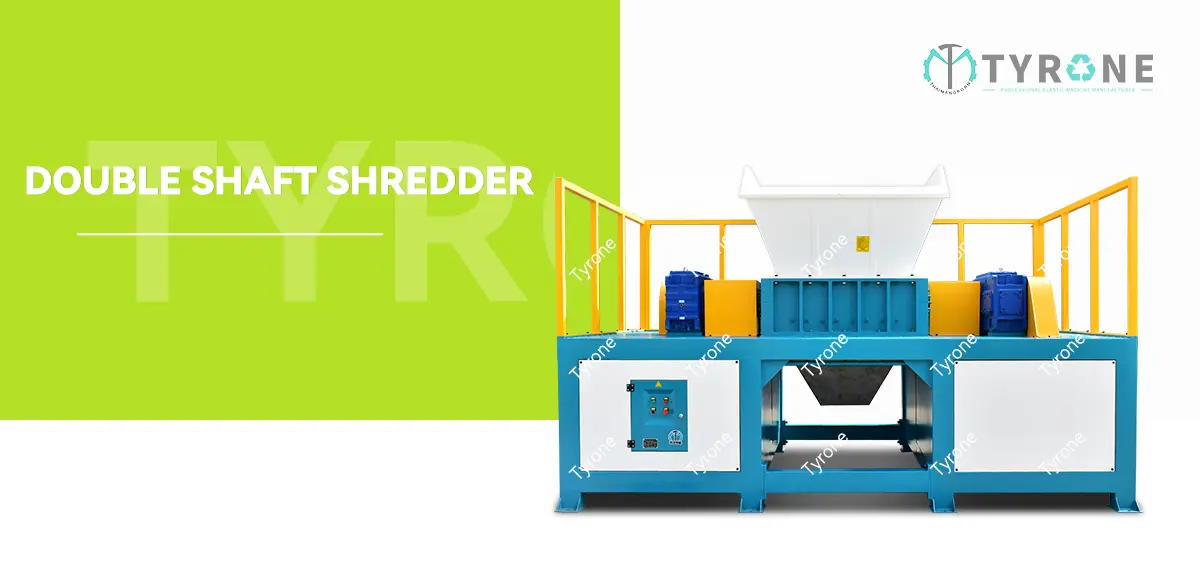
A twin-shaft shredder is a device that uses two counter-rotating cutter shafts to generate shearing and torque forces to crush and reduce the volume of materials. It is primarily used for the coarse or medium crushing pretreatment of various solid materials.
Four-shaft shredder
What is four-shaft shredder machine
A four-shaft shredder is a device that uses two pairs (four) of rotating cutter shafts to perform grading operations, achieving fine crushing of materials. It is primarily used for deep crushing and precise volume reduction of high-difficulty and high-strength materials.
Twin-shaft crusher: The “mainstay of general-purpose coarse crushing” in solid waste treatment
Double shaft shredder machine
A twin-shaft crusher uses two counter-rotating cutter shafts to generate shearing and torsional forces to crush materials. It features low speed and high torque, making it suitable for mixtures with high moisture content and complex compositions. With low maintenance costs, it is widely used in the primary crushing of various solid wastes and is a core pretreatment device in many processing scenarios. Typical applications include:
Municipal Solid Waste Treatment: This is one of the core application scenarios for twin-shaft shredders. Whether it’s ordinary household waste such as plastic bags, textiles, and kitchen waste mixtures, or long-accumulated, stale waste, it can efficiently reduce volume and shred it. For example, the application of the Sride twin-shaft shredder in a municipal solid waste treatment center in Southeast Asia has a daily production capacity of over 200 tons, laying the foundation for subsequent waste incineration, landfill, or resource recovery. Simultaneously, it can quickly dismantle and shred bulky household waste such as sofas and mattresses, significantly reducing transportation and processing costs.
General Industrial Solid Waste Treatment: It is frequently used in solid waste treatment in industries such as textiles, leather, and papermaking. Waste fabrics from textile mills, scraps from garment factories, and leather scraps from leather factories can be shredded and processed into approximately 80mm RDF (waste-derived fuel) to supply cement kilns and power plants as alternative fuel. Furthermore, waste paperboard and light slag from paper mills, as well as waste materials from shoe factories, can also be shredded and recycled, improving resource utilization. 3. Municipal and Construction Waste Treatment: In municipal and construction settings, twin-shaft shredders can process mixtures of wood, plastic pipes, waste tiles, and concrete blocks from renovation waste, solving the problem of complex and difficult-to-process construction waste. Garden waste such as branches and stumps from landscaping pruning can be converted into biomass raw materials after shredding, used to produce organic fertilizer or biomass fuel.
Special Waste Pretreatment: For small medical devices, clinical waste, and plastic and latex waste from medical waste, twin-shaft shredders can serve as pretreatment equipment to crush and reduce volume, facilitating subsequent harmless incineration. Simultaneously, it can also process special materials such as used batteries and confidential documents. Crushing the former facilitates the extraction of useful components such as internal metals, while crushing the latter achieves the dual purpose of information destruction and paper recycling.
Four-shaft shredder: A “high-precision crushing expert” for complex working conditions
Four shaft shredder
A four-shaft crusher relies on the coordinated operation of two pairs of cutter shafts. The upper cutter shaft is responsible for primary crushing and material feeding, while the lower cutter shaft performs fine shearing. The output particle size is uniform and controllable, capable of handling high-strength, highly complex, and difficult-to-process materials. It is commonly used in scenarios with high requirements for crushing precision and safety, such as the following typical applications:
Hazardous Waste Treatment: This is a key area of strength for four-axis crushers. For hazardous waste such as chemical drums, IBC containers, and containers containing contaminants, it can tear and decompose them through multi-stage crushing, preventing secondary pollution from waste leakage. The crushed residue is also easy to handle in subsequent harmless treatment. Furthermore, for contaminated industrial sludge and solid hazardous waste containing toxic components, its stable crushing performance allows operation in a sealed environment, ensuring the safety of the treatment process.
Large Industrial and End-of-Life Equipment Processing: In the heavy industry and equipment recycling sector, four-axis crushers can process high-strength solid waste such as end-of-life machine tool beds, large steel components, and thick-walled metal pipes. After introducing this equipment, a heavy industry company saw a 60% increase in efficiency in processing such solid waste compared to dual-axis equipment. The crushed metal fragments have low impurity content and can be directly used as raw materials for steelmaking. Simultaneously, it can also process large equipment such as discarded containers and giant plastic storage tanks, reducing their volume by more than 90% after crushing, significantly reducing storage and transportation costs.
Waste Electrical and Electronic Waste Processing: For dismantled household appliances such as refrigerator shells, televisions, and washing machine remnants, the four-axis shredder can precisely crush them, facilitating the subsequent separation of recyclable components such as metals and plastics. For electronic waste such as circuit boards, its precise shearing action prevents the leakage of hazardous substances during the crushing process, while simultaneously crushing the circuit boards to the appropriate particle size, aiding in the subsequent extraction of precious metals such as gold and silver.
New Energy and Special Waste Processing: Against the backdrop of the rapid development of the new energy industry, the four-axis shredder has become a key piece of equipment for the recycling of decommissioned equipment. For example, when processing decommissioned wind turbine blades, it can achieve the initial separation of glass fiber from other materials; when processing large lithium battery modules, it can precisely crush the battery casing and internal structure, providing conditions for the subsequent high-value recycling of battery materials. Furthermore, it can also achieve one-time crushing of special waste materials with high toughness and large volume, such as waste tires and plastic pallets, adapting them to subsequent recycling processes without secondary processing.