Supermarket shopping bags, packaging films, agricultural mulches—plastic films are ubiquitous, yet due to their lightweight and flimsy nature, they have become a major contributor to “white pollution.” In reality, these “thin films” can be transformed from waste into valuable resources; however, numerous bottlenecks in the recycling process result in the needless waste of vast quantities of recyclable materials. Today, we unlock the key to film recycling—leveraging specialized equipment to make the process more efficient and hassle-free.
First, clarify: Which films can be recycled?
To determine whether a film can be recycled, simply check its material and degree of contamination.
● ✓ Recyclable: Materials classified as #4 LDPE and #5 PP (e.g., supermarket shopping bags, clean courier bags, agricultural films, etc.) are recyclable once cleaned.
● × Recycle with Caution / Non-Recyclable: Materials contaminated with oil stains or mixed with PVC films can compromise the entire recycling batch if processed together, thereby increasing equipment processing costs.
Why Recycle Plastic Film? These 3 Key Benefits Cannot Be Overlooked.
1. It alleviates the environmental burden by preventing plastic films from scattering across fields or leaching into water bodies, thereby reducing “white pollution” and the hazards of microplastics, while safeguarding soil health and ecological integrity;
2. It enables resource regeneration; after specialized processing, discarded films can be transformed into recycled plastic granules, which are then utilized to manufacture products such as courier bags and drip irrigation tapes—effectively turning waste into valuable resources;
3. It lowers costs; recycling and reuse consume less energy and fewer resources than the production of virgin plastics, thereby generating additional revenue for both enterprises and the recycling sector.
Striking at the Core of Recycling Pain Points: Obstacles Hindering the Transformation of Film from “Waste to Value”
1. Household Disposal Stage: Insufficient sorting guidelines lead to improper mixing and contamination; the thin, lightweight, and bulky nature of plastic films makes them difficult to store, prompting residents—who view them as a nuisance—to discard them indiscriminately, resulting in resource waste.
2. Collection and Transport Stage: The high volume and low density of the materials result in high transportation costs; during collection and transport, the films are prone to scattering and tangling, making manual sorting labor-intensive and inefficient; furthermore, the slim profit margins and cumbersome procedures associated with recycling make collection points reluctant to accept and transport these materials.
3. Recycling and Processing Stage: Traditional equipment is prone to shaft entanglement and jamming, preventing continuous operation; the crushing process often yields uneven particle sizes and high impurity levels, resulting in recycled materials of poor quality and low market value; moreover, high energy consumption, excessive noise levels, and high maintenance costs make it difficult for recycling enterprises to generate a profit.
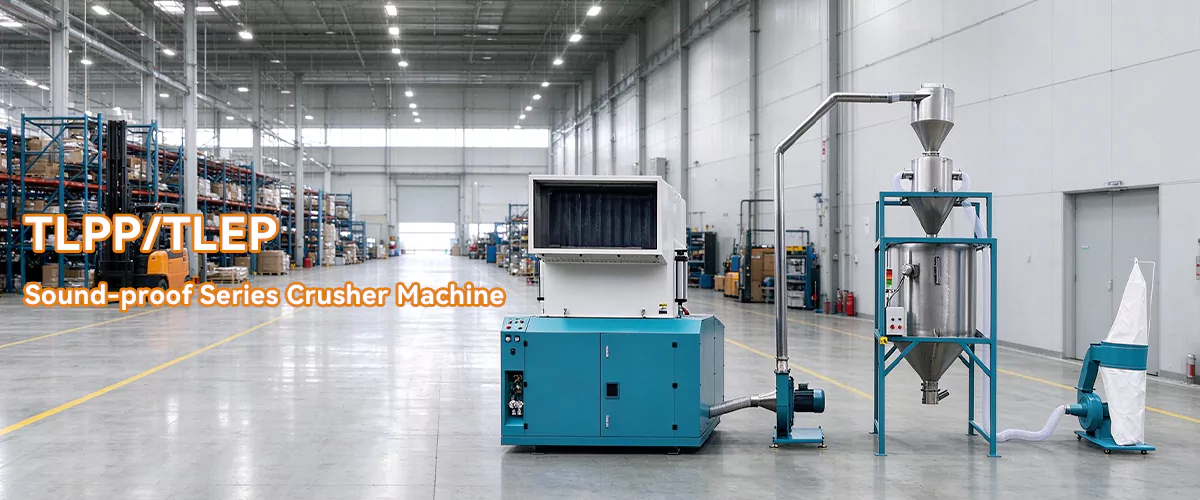
To address the aforementioned pain points across the entire workflow, selecting the right specialized equipment is the key to a breakthrough. The Tailong TLV Film Shredder was engineered specifically to tackle the challenges inherent in every scenario of film recycling; by precisely meeting the requirements of each stage and systematically resolving pain points, it serves as a pivotal asset in the film recycling process.
-1024x427.webp)
The TLV series crushers are suitable for the crushing and recycling of PP and PE films and sheets, PET bottles, and similar products.
.webp)
Anti-tangling, Stable Operation
It features an exclusive V-shaped cutter holder that employs a shearing mechanism to prevent film from entangling the rotor shaft. This results in uniform granulate, minimal dust generation, low energy consumption, and high throughput. Furthermore, it is equipped with a split-housing design and independent external bearing blocks, which prevent material contamination and dust ingress, thereby extending the service life of the equipment.
.webp)
motor dynamic intelligent control system
Optionally equipped with a motor dynamic intelligent control system, the unit demonstrates a measured energy-saving rate of over 20% compared to traditional Star-Delta starting methods, resulting in substantial reductions in electricity costs during continuous, year-round operation. It features comprehensive, multi-dimensional protection against overcurrent, overload, phase loss, overheating, and rotor lock, ensuring safer and more stable equipment operation.
.webp)
Flexible Adaptation
It can be optionally equipped with a conveyor belt, suction blower, and storage bin to form a complete recycling system, making it suitable for diverse settings ranging from community collection points to large-scale industrial operations. Featuring a compact structure, user-friendly operation, and simple maintenance, the unit boasts low energy consumption and minimal noise levels, effectively balancing environmental responsibility with high efficiency.
.webp)
Wet Grinding Capability, Robust and Durable
Featuring a robust, wear-resistant chassis, the machine ensures stable and durable operation. Its adjustable screen allows for precise control over crushed particle size, making it ideally suited for integration into washing and pelletizing workflows to enhance the purity of recycled materials. The unit supports wet grinding—withstanding the corrosive effects of moisture and steam—and can be seamlessly integrated with dust removal and cleaning systems, offering high efficiency with minimal maintenance requirements.
Thin films are by no means an insurmountable environmental burden; rather, they represent a renewable resource waiting to be unlocked. The recycling of plastic films is never the sole responsibility of a single party, but rather a shared mission involving every individual, every collection point, and every enterprise. From individuals diligently practicing sorting and proper disposal, to the recycling sector optimizing collection and transport logistics, and finally to enterprises leveraging the Tailong TLV film shredder to resolve processing challenges—every step taken contributes to the perfection of the closed-loop film recycling system. Supported by professional equipment and grounded in universal participation, the goal is to liberate every recyclable film from the fate of being “discarded,” allowing it to be reborn through circular utilization. This approach not only safeguards the ecological integrity of our natural landscapes but also unlocks the economic value of renewable resources, thereby truly achieving a symbiotic win-win scenario where ecological and economic benefits mutually reinforce one another.
.webp)

.webp)