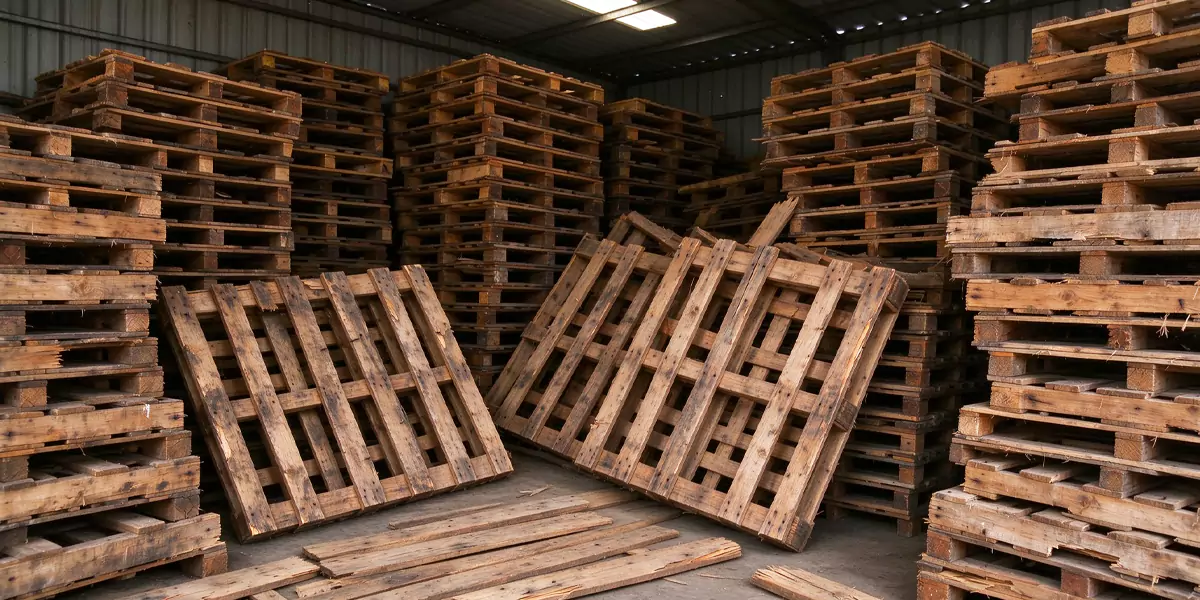
Wood pallets are the most fundamental and frequently used load-bearing units in logistics, manufacturing, warehousing and cross-border supply chains. From raw material factories, finished goods warehouses, trunk transportation to distribution terminals, wood pallets endure heavy load, impact, rain and moisture. After repeated circulation, many pallets suffer broken beams, cracked deck boards, loose nails, decay and insect damage. Once their structural strength can no longer support cargo loading, they cannot be repaired and reused, becoming bulk wood solid waste continuously generated in industrial scenarios. Many customers raise the same question: waste wood pallets are merely ordinary wood scraps. Why do we keep investing space, sorting labor, transportation capacity and complete equipment to build a full chain for systematic recycling and shredding?
The answer becomes clearer under the national top-level policy framework of circular economy, dual carbon strategy and comprehensive solid waste governance. The Comprehensive Solid Waste Management Action Plan and the 15th Five-Year Plan for Circular Economy Development are steadily implemented, adhering to the three core principles of reduction, resource recovery and harmless treatment. The country vigorously promotes the construction of “Zero-Waste Cities”, “Zero-Waste Parks” and “Green Factories”. Industrial parks, manufacturers and recycling operators are encouraged to carry out standardized recycling, cascade utilization and refined regeneration for bulk organic solid waste. Policies are transforming solid waste management: shifting from simple end-point collection and outsourced disposal to on-site volume reduction, nearby resource recovery and value-added circulation. Meanwhile, waste producers bear clear legal responsibilities. Illegal dumping, open burning and unauthorized landfilling are strictly regulated. Environmental inspections, traceability records, ESG disclosure and green factory evaluation have become regular assessment requirements for many large-scale enterprises.
Landfilling scrap wood pallets consumes limited landfill space. Wood decomposes slowly under anaerobic conditions and releases methane, a greenhouse gas far more potent than CO₂. Open burning is prohibited, as it generates smoke, particulate matter and VOCs and may lead to administrative penalties. Simply outsourcing waste collection only transfers environmental risks. It fails to meet waste reduction targets or the standards of zero-waste parks and green factories, and cannot form a closed value loop. Wood is a slow-growing biomass resource. It takes years or more for trees to mature, and forests serve as vital carbon sinks. Logging reduces forest carbon sequestration capacity. Recycling waste wood pallets extends the carbon sequestration cycle of wood fibers, replaces part of virgin timber with recycled material, reduces new logging and cuts the carbon footprint of industrial chains. It is a practical industrial approach for carbon peaking and carbon neutrality.
However, recycling wood pallets is much more challenging than processing ordinary agricultural and forestry offcuts. Waste pallets come from scattered sources with mixed specifications, including Euro pallets, domestic standard pallets and custom irregular pallets. They generally contain nails, self-tapping screws, plywood blocks, sediment, packing tape and paint. Bulky pallets occupy large storage space and bring high transportation costs. The industry follows cascade utilization by default: pallets in good condition are sorted, repaired and reused first, which is the lowest-cost and lowest-carbon recycling method. Rotten, heavily broken, moldy pallets with dense nail holes are no longer repairable and must be shredded for resource recovery.
Many simple treatment methods in the industry have certain limitations. When single-stage shredding equipment is used directly for nailed pallets, metal impurities tend to accelerate wear of consumable parts and cause frequent downtime and maintenance. A single shredder often produces coarse, uneven material with poor impurity removal and unstable finished quality. Downstream panel manufacturers, biomass pellet plants and thermal power enterprises set strict access standards for impurity content, moisture content and particle size range. Materials that fail to meet quality requirements are difficult to enter downstream markets. This is why we invest sufficient manpower, supporting equipment and complete process solutions to build a systematic recycling system: compliance is the premise, stable and controllable raw material quality is the core, and low-carbon sustainable circulation is the long-term direction.

Based on national policy guidance and the material challenges of nailed, bulky, tough and impurity-rich wood pallets, Tyrone recommends the two-stage complete shredding solution: dual-shaft primary shredder + hammer mill fine shredder. Our equipment selection and process layout are not designed merely to break materials. We consider standardized solid waste treatment, energy saving, carbon reduction, continuous stable production and standardized finished products, balancing material characteristics, maintenance cost, repair difficulty, product indicators and long-term customer benefits.

Stage 1: Dual-shaft primary shredder. It adopts low-speed high-torque shearing structure. Whole pallets can be fed directly without manual disassembly or nail removal. Two interlocking cutter shafts shear and tear large wood blocks. It resists hard impurities such as nails and wooden blocks, avoids shaft wrapping and blockage, and supports long continuous operation. After primary shredding, a permanent magnetic separator efficiently removes iron nails and metal fragments. It protects downstream fine crushing equipment and meets iron impurity limits for recycled raw materials.
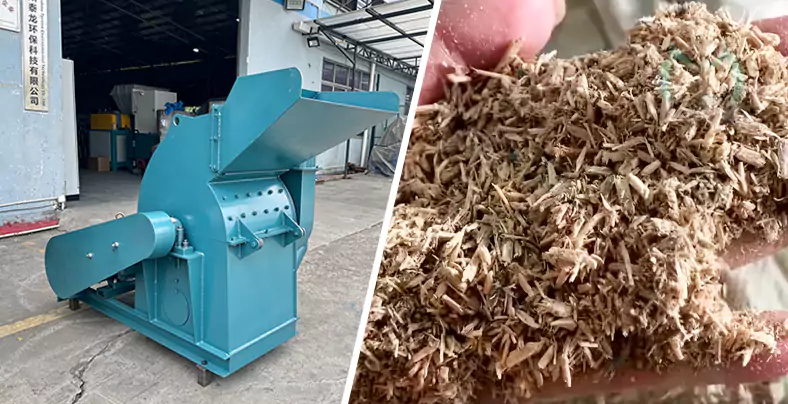
Stage 2: Hammer mill fine shredder. Iron-free clean coarse material enters the hammer mill. High-speed hammers strike and grind the material, while the bottom screen controls particle size to produce uniform wood chips and pellets. By replacing screens with different apertures, particle size can be adjusted flexibly to match raw material standards for wood panels, biomass pellets, landscape mulch and other downstream sectors, opening multiple recycling sales channels.
Workload sharing between two stages. Compared with one-step heavy-impact shredding, the two-stage process separates shearing and fine grinding, lowering overall energy consumption. Dust sources are concentrated for easy collection and treatment by dust removal systems, complying with green low-carbon production. Volume reduction is remarkable: bulky waste pallets gain much higher bulk density after shredding, cutting storage and transit costs, in line with the circular economy principle of local recycling and on-site utilization.
Wood chips and pellets processed through this compliant full process are no longer solid waste requiring paid disposal, but marketable standardized recycled biomass raw materials. Their applications are highly aligned with policy incentives:
✅ Biomass fuel: Further processed into biomass pellets for biomass boilers and power plants to replace high-carbon fossil fuels such as coal. This is a state-supported renewable biomass utilization route and supports clean transition of industrial heating and energy structure;
✅ Raw material for wood-based panels: Low-impurity clean wood fibers are supplied to particle board, MDF and fiberboard manufacturers, returning to panel, furniture and packaging chains to realize closed-loop wood circulation and reduce virgin timber consumption;
✅ Agricultural & horticultural auxiliary material: Used as landscape mulch for weed suppression and moisture retention, or compost amendment for organic fertilizer plants. Clean wood pellets can also be bedding for horse farms and livestock breeding, absorbing moisture and improving breeding conditions;
✅ Other niche applications: Edible fungus cultivation substrate, wood powder filler, special papermaking raw material, etc.
Recycling waste wood pallets is far more than simple scrap processing. It is practical implementation of national circular economy, solid waste governance and dual carbon strategies. For waste producers, it helps fulfill waste reduction indicators and meet assessment requirements of zero-waste parks, green factories and ESG. For recycling plants, it turns costly waste into marketable recycled raw materials, achieving carbon reduction and profit growth at the same time.
Tyrone focuses on solid waste shredding and recycling equipment and keeps up with domestic circular economy policies. We do not merely sell shredders. For bulky, nail-containing wood waste such as pallets, we provide full resource recovery solutions including scheme planning, equipment selection, process layout, dust removal & magnetic separation accessories and operation guidance. With the proven two-stage process of dual-shaft primary shredder + hammer mill fine shredder, we help customers build the full chain: waste pallets → primary shredding & impurity removal → controlled fine shredding → standardized wood chips & pellets. We balance compliant production, low-carbon emission reduction and stable revenue, and jointly promote high-quality and sustainable development of the wood waste recycling industry.