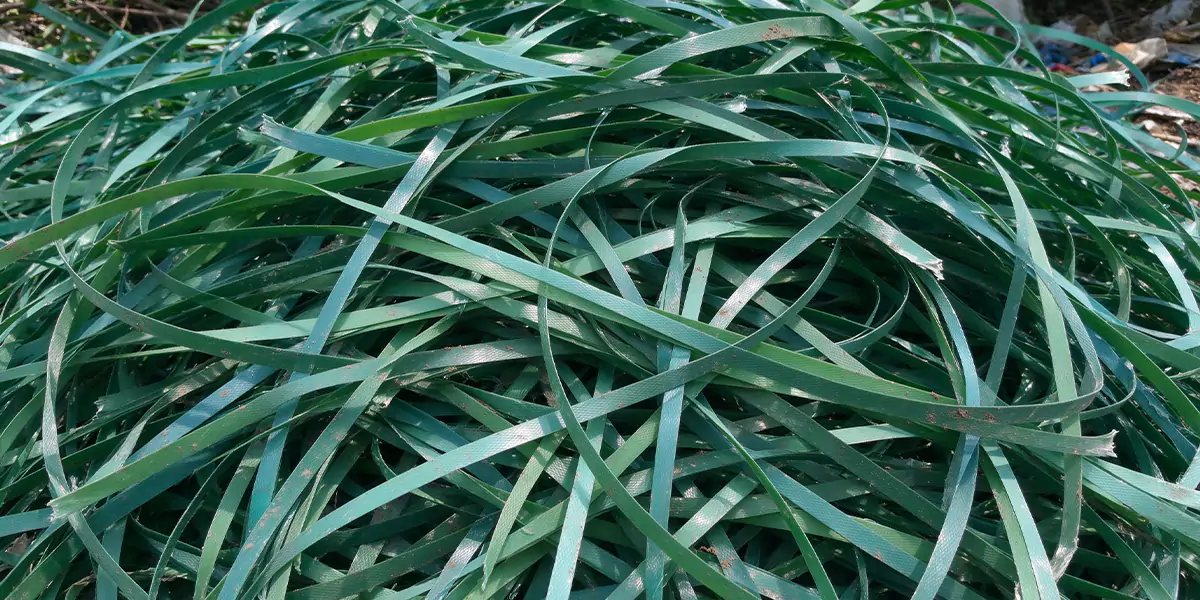
The New Plastics Economy Report puts forward a core argument: the prevailing linear economic model — extracting petrochemical raw materials, manufacturing products, single-use consumption, followed by landfill or incineration — is essentially a resource-depleting model. Plastic does not disappear; it merely changes form and disperses into the environment. Across the whole workflow of industrial production, warehousing, logistics and finished goods delivery, PP plastic straps represent a large-volume yet often overlooked type of industrial waste.
Almost every manufacturing plant, trading company and warehouse generates substantial waste straps every day: straps used for bundling raw materials, straps removed from finished goods packages, broken offcuts and aged straps that can no longer be reused. Many enterprises simply mix these waste straps with general rubbish and pay for third-party solid waste disposal, or stockpile them idly. In this process, high-quality PP raw material with pure composition and excellent recyclability is discarded as ordinary waste.
Recycling plastic straps is not a superficial compliance project for environmental policies. Instead, it is a practical solution that converts linear resource consumption into closed-loop regeneration. Whether strap recycling can deliver stable profits and qualified regrind quality hinges on the first critical step: crushing. Plastic straps feature high toughness, long strip shape and a tendency to tangle easily. Ordinary crushing equipment struggles to process them steadily, which is the key reason why many factories abandon strap recycling plans even with waste stock available. Our V-type crusher is specially developed for tough materials such as PP straps, soft films and sheets. It addresses the common pain points in strap crushing and turns waste straps into recyclable, high-value regrind.
I. Core Value of PP Strap Recycling: Integration of Resource, Environmental and Operational Benefits
PP straps are mainly made of polypropylene. Featuring single material composition and relatively low impurity content, they are widely recognized feedstock in the recycled plastic market. Many plant managers may wonder: a single strap roll is inexpensive, so how much profit can waste strap recycling bring? We can break down its value from three dimensions: resource consumption, environmental impact and corporate cost efficiency.
1. Resource Conservation: Cutting Consumption of Crude Oil and Virgin Resources
Polypropylene is a petrochemical derivative. Producing one tonne of virgin PP pellets consumes crude oil, large volumes of electricity and water, alongside carbon emissions generated during refining and polymerization. Industry data shows that recycling one tonne of PP regrind saves approximately 88% of processing energy consumption compared with manufacturing one tonne of virgin PP, lowering crude oil usage and greenhouse gas emissions. If waste straps are not recycled, they will end up in landfill or incineration. PP plastic takes hundreds of years to degrade naturally. Landfill occupies land for a long time and carries risks of soil and groundwater contamination via leachate. Incineration reduces waste volume yet produces flue gas and fly ash, requiring expensive treatment while representing a complete waste of resources. Recycling enables repeated circulation of petrochemical resources that have already been extracted and processed once. It replaces continuous virgin resource exploitation with resource reuse, easing the demand for non-renewable fossil feedstock.
2. Economic Benefits: Measurable Long-Term Cost Savings and Extra Revenue
This is the primary concern for enterprises. The economic returns of strap recycling fall into three categories: First, reduced solid waste disposal fees. Industrial solid waste collection and treatment are charged by tonnage. Higher waste output means higher annual disposal expenditure. On-site crushing and recycling of self-generated waste straps cuts the quantity of waste for external haulage, delivering lasting savings on waste treatment. Second, lower raw material procurement costs. After crushing, washing and pelletizing, recycled PP pellets can be reused to produce new straps, injection-molded packaging parts and plastic auxiliary components when quality is stable. Virgin PP prices fluctuate constantly, and a consistent price gap exists between virgin and recycled PP. Internal recycling of on-site waste reduces purchases of virgin feedstock and hedges against raw material price hikes. Third, additional revenue and compliance with green supply chain requirements. If internal waste strap output exceeds self-consumption, crushed flakes or recycled pellets can be sold to pelletizing plants and injection molding factories for extra income. Meanwhile, an increasing number of key downstream clients and foreign trade orders require suppliers to provide carbon footprint documentation and green supply chain records. A stable internal strap recycling system demonstrates waste recycling capacity, meets green audit standards and helps secure high-value orders, building competitive advantages over peers.
3. Industry Pain Points: Why Many Factories Fail to Launch Strap Recycling
Plastic straps are soft, highly tough, thin, long and elastic — notoriously difficult materials for crushing. Many factories that test recycling with conventional shredders or flat-knife crushers encounter frequent troubles:
- Material tangles around the rotor, causing frequent blockages, manual shutdown cleaning, low throughput and high labor costs;
- The machine rips straps apart by force, producing fibrous and flocculent fragments with excessive fine powder and low usable flake yield;
- Heavy dust leads to massive material loss, and fine powder with no commercial value constitutes secondary waste;
- Uneven particle size, filament and agglomerates raise difficulties in downstream washing and pelletizing, downgrading regrind quality and resale value;
- Dust invades bearings, and lubricating oil may leak into the crushing chamber, contaminating materials. Equipment suffers frequent breakdowns and high maintenance frequency.
Simply put: straps are valuable for recycling, yet improper crushing equipment turns recycling into a troublesome, low-profit activity. To unlock the value of strap recycling, a shear-type crushing solution tailored for soft tough materials — the V-type crusher — is required.
II. V-Type Crusher: Shear Crushing Equipment for PP Straps, Soft Films and Sheets

The V-type crusher processes a wide range of industrial waste plastics: PP packing straps, PP woven bags, PE films, plastic sheets, PET bottles and more. Its core design differs fundamentally from traditional shredders that tear materials. Equipped with a V-shaped knife holder and adopting shear working principle, it cuts materials cleanly instead of tearing them violently. It supports smooth in-feeding of straps for continuous stable processing of long tough straps.
1. Shear Crushing Principle: Eliminate Filaments and Excessive Dust from the Source
Conventional crushers break materials by pulling and impact. Due to high toughness, straps are stretched and torn into countless fine filaments and powder during ripping. The V-type crusher uses paired cutting edges arranged in a V-shape that engage like scissors, cutting incoming straps neatly. The advantages are directly reflected in finished regrind: sharply defined, uniformly sized particles with drastically reduced dust output and higher usable flake ratio. Uniform flakes flow better in washing tanks, friction washers and pelletizers without bridging or blocking. They are easier to clean, yielding recycled pellets with higher purity, stable appearance and better market value. For similarly tough soft materials such as PP woven bags, optional large oblique staggered knives can be configured to optimize shear performance and expand material adaptability.
2. Split Open Housing + Independent External Bearing Blocks: Guarantee Material Cleanliness and Extend Machine Life
This structural design is critical and essential for packaging waste processing. Bearing blocks are mounted externally and fully isolated from the crushing chamber. Two key benefits: ① Lubricating oil is contained and prevented from leaking into the crushing chamber, avoiding oil contamination of lightweight materials such as straps and films. No extra de-oiling process is needed; ② Dust and plastic debris generated during crushing cannot enter bearings through shaft gaps, reducing abrasive wear, preventing bearing seizure, extending service life, cutting downtime and lowering maintenance costs. The split open housing enables easy access for knife inspection, cavity cleaning and residue removal without complicated disassembly. It supports frequent material switching between straps, films, PET bottles and other feedstock.
3. Wet Crushing Available, Compatible with Auxiliary Machines for Integrated Crushing, Dust Removal and Primary Washing
The V-type crusher supports wet crushing, a highly valuable feature for strap recycling. Water injection during shearing suppresses dust rapidly, lowering workshop dust concentration, improving working conditions and meeting environmental control requirements. Water also cools and lubricates cutting edges, reducing frictional heat and boosting throughput. Modular auxiliary equipment is optional: friction washer and screw feeder. The screw feeder delivers straps at a steady, uniform feed rate for smooth soft feeding, eliminating blockages caused by inconsistent manual feeding. Paired with a friction washer, the system removes dirt, sand and label residues after crushing, realizing primary washing and dust removal in one step. This simplifies the layout of recycling lines and reduces equipment investment and floor space.
4. Multi-Material Compatibility: Improve Equipment Utilization and Reduce Capital Expenditure
Most factories generate mixed waste streams. Besides daily PP straps, waste PE packaging films, plastic sheets and PET bottles are also common. The V-type crusher can handle multiple materials without machine replacement, merely by adjusting knife gaps and selecting appropriate knife types. One machine consumes various plastic packaging wastes on site, lifting equipment utilization. Separate crushers for different wastes are unnecessary, spreading out fixed investment.
III. The Logic of Strap Recycling: Premium Regrind Starts with Reliable Crushing
Many people misunderstand recycling as simple waste collection. In fact, the recycling chain is interconnected: waste collection → crushing → washing → dewatering → pelletizing. Crushing is the first process. The quality of crushed flakes determines the difficulty of all downstream processes and the final value of recycled pellets. Filaments, excessive dust, oil contamination and uneven particle size increase washing costs, cause screen blockage and black specks during pelletizing, downgrade regrind quality and may force low-price disposal. By adopting shear cutting, the V-type crusher achieves stable soft feeding and continuous shearing of long straps, producing clean, uniform, low-dust qualified flakes. It lays a solid foundation for subsequent washing and pelletizing, transforming strap recycling from a burdensome environmental task into a stable, controllable and profitable resource loop.
Conclusion
Circular economy is not an abstract industry slogan. It is realized in every unpacking operation and every roll of discarded strap in factories. Recycling PP straps reduces petrochemical consumption, cuts carbon emissions and mitigates solid waste pollution externally. Internally, it curbs waste disposal spending, offsets raw material price rises and builds green supply chains, delivering tangible economic gains. The V-type crusher acts as core equipment to close the strap recycling loop. It replaces tearing with shearing, resolving typical pain points of soft strap processing: tangling, filament generation, heavy dust, material contamination and frequent failures. It enables steady feeding, high-efficiency crushing and consistent regrind quality. It helps manufacturers convert packaging waste into premium raw materials, cutting operational costs while advancing sustainable plastic circular solutions.